Team Neemopani
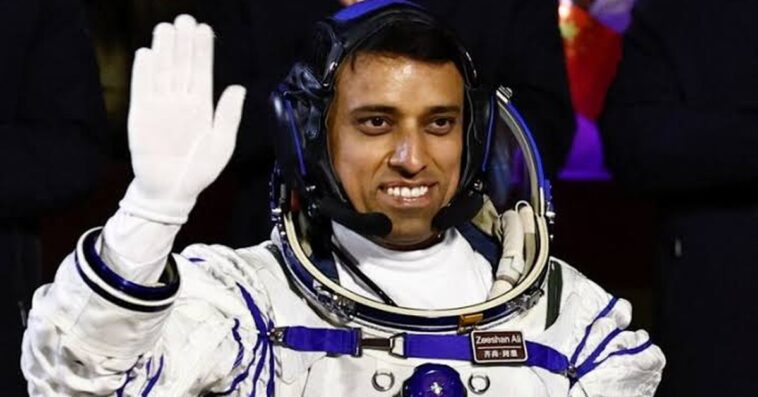
Pakistan has a new hero, and his name is trending everywhere. Zeeshan Ali astronaut Muhammad Zeeshan Ali made history on 25 November 2026 when he became the first Pakistani to reach orbit. He flew on China’s Shenzhou-24 mission and, a few hours later, became the first foreign astronaut ever to enter China’s Tiangong space station.
Many people online are asking if Zeeshan went to the Moon. In fact, he did not. Instead, he went to a space station orbiting the Earth, which is still a huge first for Pakistan. So, here is everything you need to know about him, his mission and what comes next.
Who Is Zeeshan Ali, Pakistan’s First Man in Orbit?
Muhammad Zeeshan Ali is a 40-year-old Pakistan Air Force fighter pilot. According to reports, he holds the rank of Wing Commander. On the Shenzhou-24 mission, he serves as the payload specialist, which means his main job is to run scientific experiments.
| Detail | Information |
|---|---|
| Name | Muhammad Zeeshan Ali |
| Age | 40 |
| Background | Pakistan Air Force fighter pilot (Wing Commander) |
| Mission | Shenzhou-24 |
| Role | Payload specialist |
| Launch | 25 November 2026, 5:18 AM PKT |
| Launch site | Jiuquan Satellite Launch Centre, China |
| Rocket | Long March-2F |
| Destination | Tiangong space station |
| Stay | About one week |
How the Journey to Space Began
The story started in February 2025, when Pakistan’s space agency SUPARCO signed an agreement with the China Manned Space Agency (CMSA). Under that deal, China agreed to train two Pakistani astronauts, and one of them would fly to Tiangong.
After a three-stage selection covering medical, psychological and technical tests, SUPARCO picked Zeeshan Ali and Khurram Daud in April 2026. Shortly after, Prime Minister Shehbaz Sharif met both men before they left for China. Then they spent about seven months at the Astronaut Centre of China, where they trained on spacecraft systems, emergency drills, zero-gravity work and even the Chinese language.
Shenzhou-24 Launch and Arrival at Tiangong
Finally, on Wednesday, 25 November 2026, at 5:18 AM Pakistan time, a Long March-2F rocket lifted off from the Jiuquan Satellite Launch Centre. On board were commander Tang Hongbo, pilot Wu Yi and astronaut Zeeshan Ali.
Just over six hours later, the spacecraft docked with Tiangong. As a result, Zeeshan became the first international visitor to China’s space station. Notably, Shenzhou-24 is the 12th crewed mission to Tiangong.
What Is Astronaut Zeeshan Ali Doing in Space?
During his week on the station, Zeeshan is working on joint Pakistan-China science. According to SUPARCO, the four joint experiments are:
- Hybrid Composite Shield: testing graphene-based materials for radiation shielding.
- Self-Healing in Space: studying carbon-fibre materials that repair themselves.
- Quinoa Beyond Earth: checking how quinoa seeds survive microgravity and radiation.
- Green Life Beyond Earth: using microalgae and cyanobacteria for life support.
In addition, Pakistani universities sent in more than 300 research proposals for this mission, which shows how much interest it has created at home.
Did Zeeshan Ali Go to the Moon?
No, and this is the biggest confusion on social media right now. Tiangong orbits roughly 400 km above the Earth, while the Moon is about 384,000 km away. So, Zeeshan is in low Earth orbit, not on the Moon.
Still, the Moon is part of the story. Before the flight, he told his family that even though he would travel farther from home than ever before, “we will still share the same Moon.” Moreover, he said he hopes Pakistan and China will fly together “to the Moon, Mars and beyond.” Pakistan already has a lunar link too: in 2024, its ICUBE-Q satellite flew to the Moon on China’s Chang’e-6 mission.
What Did Zeeshan Ali Say Before Launch?
At a press briefing in China, Zeeshan thanked the Chinese government and said he carried the hopes of 250 million Pakistanis. He also called the flight “not a finish line; it is a launch pad.” Additionally, he recalled the Prime Minister telling him that they were about to write a new chapter in Pakistan’s history.
When Will Zeeshan Ali Return to Earth?
Zeeshan’s trip is a short visit of about one week. After that, he will return to Earth with the Shenzhou-23 crew. Meanwhile, Tang Hongbo and Wu Yi will stay on Tiangong for around six months. Chinese astronaut Zhu Yangzhu will stay for about a year, which would be a Chinese record.
Why This Is a Big Moment for Pakistan
Overall, this mission puts Pakistan in a small club of countries that have sent their own astronaut into orbit. It also gives SUPARCO real experience in human spaceflight, years after Pakistan approved its first National Space Policy. Above all, it could inspire a whole generation of young Pakistanis to study science and engineering.
If you are curious why humans have not returned to the Moon in decades, read our explainer on what is keeping humans from landing on the Moon again. For mission photos and official updates, visit the SUPARCO Mission Hub and the launch report on Space.com.
Frequently Asked Questions
Did Zeeshan Ali go to the Moon?
No. Instead, astronaut Zeeshan Ali flew to China’s Tiangong space station in low Earth orbit, about 400 km above the Earth. However, he has said he hopes Pakistan and China will one day fly together to the Moon and Mars.
Who is Muhammad Zeeshan Ali?
He is a 40-year-old Pakistan Air Force pilot who became the first Pakistani to reach orbit when he launched on China’s Shenzhou-24 mission on 25 November 2026.
Is Zeeshan Ali the first Pakistani in space?
He is the first Pakistani in orbit. Earlier, in October 2023, Namira Salim flew to the edge of space on a short suborbital Virgin Galactic flight, so she was the first Pakistani to reach space.
How long will Zeeshan Ali stay in space?
He is on a short visit of about one week. After that, he will return to Earth with the Shenzhou-23 crew.
Who flew with Zeeshan Ali on Shenzhou-24?
Commander Tang Hongbo and pilot Wu Yi of China flew with him. Both of them will stay on Tiangong for about six months.
What experiments is Zeeshan Ali doing in space?
SUPARCO lists four joint experiments: radiation shielding with graphene composites, self-healing carbon fibre, quinoa seeds in microgravity, and microalgae for life support.