Ammara
If you’ve ever spent five minutes scrolling through the comment section of a Coke Studio Pakistan track on YouTube, you’ve likely seen variations of the exact same phenomenon:
“I don’t speak a single word of this language, but my soul just left my body.”
“This song made me levitate through my bedroom ceiling.”
“They weren’t lying. I literally just ascended to heaven.”
Coke Studio started as a corporate franchise in Brazil in 2007, yeah, that’s right BRAZIL. I bet you didn’t know that little fun fact. It was transformed by producer Rohail Hyatt and the Pakistani creative team into something radically different: a global cultural blueprint. Coke Studio Pakistan didn’t just record songs, they built an audio + visual sanctuary that bridges ancient spiritual heritage, global pop culture, and high art production.
But how does a music show consistently produce songs that feel less like digital audio files and more like out of body experiences? Here is the complete breakdown of the history, the musical masterplan, and the specific sonic science that makes listeners feel like they’re floating.
1. The Masterplan: How Coke Studio Reengineered Fusion Music
Before Coke Studio Pakistan debuted in 2008, musical “fusion” often felt forced, a gimmick where an Eastern melody was haphazardly slapped on top of a standard Western pop beat. Coke Studio inverted this model.
The Unlikely Chemistry
The core formula relies on pairing wildly contrasting worlds that shouldn’t work on paper, yet lock together like lost lovers:
- Centuries old Sufi poetry merged with 80s synth-wave bass lines.
- Balochi folk rhythms blended with hip-hop and reggae syncopation.
- Operatic classical legends singing alongside raw indie artists.
When Ali Sethi and Shae Gill’s Pasoori dominated global charts, it wasn’t just because it was catchy, but because it disguised a complex, centuries old folk melody (Rag adjacent structural phrasing) inside a bouncy, modern reggaeton beat. The brain encounters the familiar modern beat, gets surprised by the vocal phrasing, and registers an instant dopamine rush. (Bet you know a little something about dopamine rush)
2. 5 Iconic Tracks That Defined the Formula
To understand how this musical engine functions across different genres, you only need to look at five pivotal releases:
| Track & Artists | The Musical Alchemy | Why It Works |
| Jugni (Arif Lohar & Meesha Shafi) | Traditional Punjabi folk paired with heavy electric guitar riffs and house percussion. | The contrast between Arif Lohar’s booming folk vocals and Meesha Shafi’s rock-infused cadence created the show’s first viral global crossover. |
| Tajdar-e-Haram (Atif Aslam) | A modern re-imagining of the iconic Sabri Brothers Qawwali. | It starts with minimal ambient instrumentation, slowly building a wall of acoustic guitars, traditional tabla, and backing choruses over nearly 10 minutes. |
| Afreen Afreen (Rahat Fateh Ali Khan & Momina Mustehsan) | Nusrat Fateh Ali Khan’s classic composition translated into an acoustic unplugged ballad. | Blends complex classical vocal improvisations (sargam) with soft, accessible pop arrangements. |
| Pasoori (Ali Sethi & Shae Gill) | Middle Eastern oud motifs, acoustic strumming, and synth-pop grooves. | Proved that regional language tracks can achieve global radio rotation through sheer rhythmic infectiousness. |
| “Blockbuster” (Faris Shafi, Umair Butt & Gharwi Group) | Punjabi rap combined with raw, traditional folk choir vocals and Punjabi street percussion (dhol). | Highlights the evolution into high-energy, modern street-style anthems without losing regional folk roots. |
The Science of “Ascending”: How the Audio Triggers Euphoria
So, why do these tracks trigger comments about “levitating”? It comes down to three deliberate production techniques:
A. The Art of the Slow Acceleration
Standard radio pop delivers its main chorus within the first 30 seconds to cater to short attention spans. Coke Studio Pakistan practices patient acceleration.
- The Foundation: Tracks frequently begin with a single isolated instrument; a solitary rubab, a quiet acoustic chord, or an ambient synth pad.
- The Micro Build: Hand percussion (dholak, tabla) enters lightly, establishing a hypnotic, circular tempo.
- The Crescendo: Over 5 to 8 minutes, layers of bass, backing vocal harmonies, brass, and distorted guitars stack on top of each other.
By the time the vocalists reach their highest register, your brain has been primed by minutes of steady rhythmic repetition. When the soundscape finally explodes into full arrangement, the tension release feels physically euphoric.
[Quiet Solo Instrument] ➔ [Hypnotic Loop] ➔ [Layered Strings & Drums] ➔ [Full Ensemble Climax (“Ascension”)]
Spiritual Roots Designed to Induce Trance (Wajd)
Much of the lyrical repertoire is drawn from historical Sufi poets like Bulleh Shah, Amir Khusrau, and Sultan Bahu.
Sufi music was historically composed for Sama spiritual gatherings designed to induce Wajd (a state of emotional surrender or trance). The repetitive phrasing of divine love, longing, and existential devotion acts almost like a rhythmic mantra. You don’t need to speak Urdu, Punjabi, or Balochi to feel the emotional frequency; the tone, resonance, and sheer vocal power communicate directly to the listener’s nervous system.
The Live Studio Energy & Visual Sanctuary
Unlike tracks produced by emailing vocals back and forth between isolated vocal booths, classic Coke Studio is anchored around a live house band sharing a physical room.
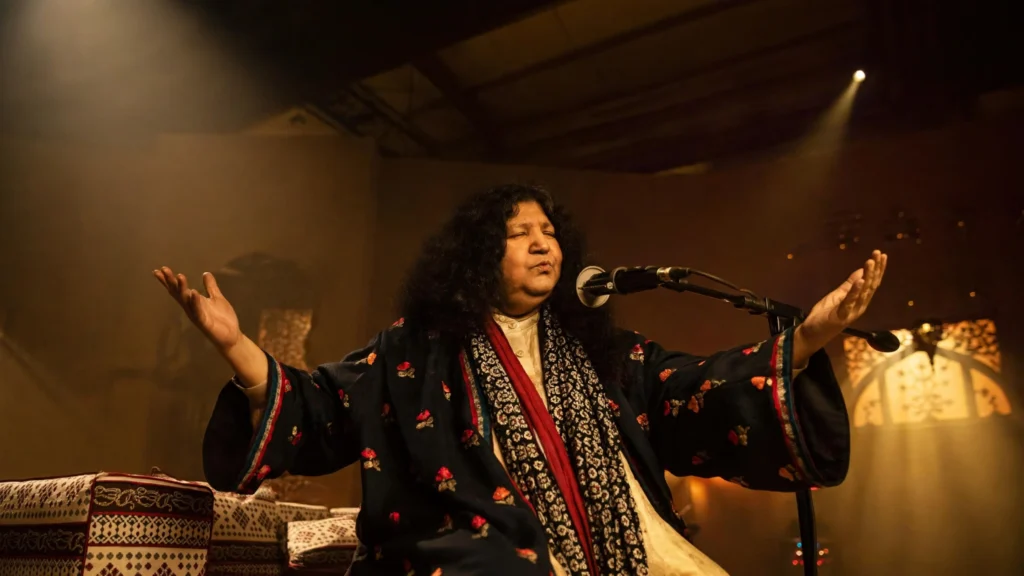
- Intimate Lighting: Warm amber lamps, Persian carpets, and deep shadow work make the set feel like a sacred jam session rather than a corporate soundstage.
- Human Imperfection & Real-Time Connection: You see the lead singer lock eyes with the tabla player during an unscripted vocal run. That shared human energy gives the audio a breathing, organic dynamic that over-quantized digital pop lacks.
The Verdict
Coke Studio Pakistan succeeded globally because it never compromised on depth or pure art. It proved that you don’t need to strip away local heritage, minority languages, or complex spiritual poetry to reach a worldwide audience, you just need to produce it with absolute reverence and world class skill.