Team Neemopani
A Pakistani musicologist represented the country at an international scholarly conference in Kyrgyzstan during the World Nomad Games 2026, held from August 31 to September 6. His research paper on a Lahore-based musical community was accepted into peer-reviewed conference proceedings. This is the kind of cultural win Pakistan rarely gets to celebrate.
Talk of going beyond connectivity with Central Asia has filled Pakistani policy circles ever since the Soviet Union broke up and the Central Asian Republics became independent. Roads, rail, energy pipelines and cultural ties have all been promised repeatedly. As reported by thenews.pk, the reality has been far more modest than the ambition. But the World Nomad Games 2026 gave Pakistan a small, genuine reason to feel good.
Quick Facts
- The World Nomad Games 2026 took place in Kyrgyzstan from August 31 to September 6.
- The accompanying International Conference on Cultural Heritage brought together 43 scholars from 23 countries in person, plus 20 more online.
- Dr Muhammad Zafar Iqbal from the National College of Arts, Lahore, represented Pakistan at the conference.
- His paper was titled An Introduction to the Musical Traditions of the Mir Alam Community Living in the Peripheries of Lahore, Pakistan.
- The International Traditional Music Festival Kocmondor Sanaty featured 77 performers from 38 countries.
What Actually Happened At The World Nomad Games
The World Nomad Games 2026 was not just a sports event. It brought together three major components: sports, science and cultural heritage. The scholarly side of things unfolded at the Ruh Ordo Cultural and Ethnographic Centre in Cholpon-Ata, Kyrgyzstan.
The International Conference on Cultural Heritage of the World’s Nomadic Peoples was organised by the Ministry of Higher Education, Science and Innovation of the Kyrgyz Republic. It ran for two days and drew 43 scholars from 23 countries physically into the room, with another 20 joining online. That is a serious academic gathering by any measure.
Pakistan’s representative was Dr Muhammad Zafar Iqbal, who is associated with the Department of Musicology at the National College of Arts in Lahore. He presented research on the Mir Alam Community Living in the Peripheries of Lahore, Pakistan. The paper was highly appreciated and made it into the peer-reviewed conference proceedings, which is a concrete academic achievement, not just participation for the sake of it.
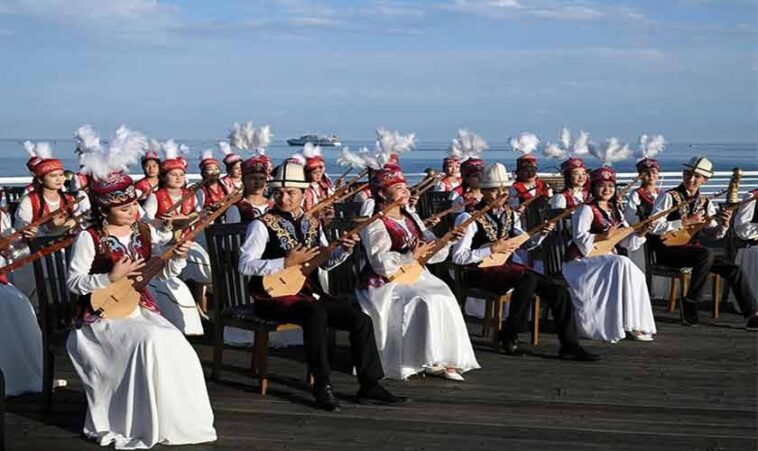
Alongside the conference, the International Traditional Music Festival Kocmondor Sanaty, or Heritage of the Nomads, was held at the same venue under the Ministry of Culture, Information and Youth Policy of the Kyrgyz Republic. Three categories were contested: storytelling, instrumental art and vocal-instrumental art. Seventy-seven performers from 38 countries took part, including 60 international performers and 17 from Kyrgyzstan itself.
Why It Matters To Pakistan
Central Asian cultures and the cultures of north India have been in conversation for centuries. That shared history shaped music, poetry, language and daily life across the region. Pakistan, as an heir to that tradition, has a genuine cultural stake in these relationships, not just a diplomatic or economic one.
Yet cultural exchanges have been, as the source puts it, disappointing in realising their potential. Of all the forms of engagement, cultural interaction requires the least investment compared to building roads or laying rail tracks. The fact that even this easier path has been so underused makes Dr Zafar Iqbal’s participation feel more significant, not less.
It also matters because Dr Zafar Iqbal has made important contributions at both the practical and theoretical levels of musicology, according to thenews.pk. Bringing research on a community living on the peripheries of Lahore to an international peer-reviewed forum puts Pakistani scholarship on a documented global record. Academic efforts like this carry weight beyond what the headlines suggest, and they build a foundation that purely infrastructure-focused engagement simply cannot.
Pakistan’s ties with Central Asia have long been framed around roads and pipelines. Cultural engagement offers something different: it builds familiarity, goodwill and shared identity that no infrastructure project can manufacture. You can read about how shifts in domestic policy shape the environment in which such international engagements happen, but the cultural dimension runs on its own track and deserves its own sustained attention. Historical impediments, as the source notes, have proven far harder to dismantle than early optimism suggested. But events like the World Nomad Games create a genuine opening.
What Happens Next
What is clear is that the conference proceedings will now include Dr Zafar Iqbal’s paper, giving Pakistani musicology a documented presence in a respected international academic record. That is a foundation others can build on.
For Pakistan more broadly, the question is whether moments like this get institutionalised or remain one-off victories. The Central Asian Republics are not going anywhere, and deeper regional cultural ties remain an area where progress has consistently fallen short of potential. The seasons change and so do geopolitical windows, and this one deserves to be used well.
Whether Pakistan sends more scholars, musicians and artists to future editions of the World Nomad Games or similar platforms will depend on institutional will. The talent is clearly there. The stage exists. What remains is sustained commitment from the organisations and ministries that can make it happen consistently, not just occasionally. Stories of Pakistani initiative operating quietly but with real substance, much like female cab-hailing services built by and for women, remind us that ambition can translate into action when the will is there.
Frequently Asked Questions
What are the World Nomad Games 2026?
The World Nomad Games 2026 is an international event held in Kyrgyzstan from August 31 to September 6 combining sports, science and cultural heritage. It included an academic conference on nomadic cultural heritage and a traditional music festival, alongside the sporting competitions.
Who represented Pakistan at the World Nomad Games 2026 conference?
Dr Muhammad Zafar Iqbal represented Pakistan at the International Conference on Cultural Heritage of the World’s Nomadic Peoples. He is associated with the Department of Musicology at the National College of Arts in Lahore and has made important contributions at both practical and theoretical levels.
What did Dr Muhammad Zafar Iqbal present at the World Nomad Games conference?
Dr Zafar Iqbal presented a research paper titled An Introduction to the Musical Traditions of the Mir Alam Community Living in the Peripheries of Lahore, Pakistan. The paper was well received and included in the peer-reviewed conference proceedings.
Where was the cultural conference held during the World Nomad Games 2026?
The International Conference on Cultural Heritage of the World’s Nomadic Peoples took place at the Ruh Ordo Cultural and Ethnographic Centre in Cholpon-Ata, Kyrgyzstan. It was organised by the Ministry of Higher Education, Science and Innovation of the Kyrgyz Republic.
How many countries participated in the World Nomad Games 2026 music festival?
The International Traditional Music Festival Kocmondor Sanaty featured 77 performers from 38 countries. Of these, 60 were international performers and 17 were participants from Kyrgyzstan itself, competing across three categories: storytelling, instrumental art and vocal-instrumental art.
Why have Pakistan-Central Asia cultural exchanges been slow to develop?
According to thenews.pk, historical impediments have proven far harder to dismantle than initially hoped after the Central Asian Republics became independent. Even cultural exchanges, which require far less investment than infrastructure projects, have fallen short of their potential.
What is the Mir Alam community that Dr Zafar Iqbal researched?
The Mir Alam community is described in Dr Zafar Iqbal’s paper as a community living in the peripheries of Lahore, Pakistan, with distinct musical traditions. His research on those traditions was the subject of his internationally presented and accepted academic paper at the World Nomad Games 2026 conference.
Final Thoughts
Pakistan and Central Asia share centuries of cultural history, but turning that heritage into active, ongoing exchange has been painfully slow. Dr Zafar Iqbal’s participation at the World Nomad Games 2026 is a small but real proof that Pakistani scholarship can hold its own on an international stage. The hope is that it does not remain an isolated moment.
Related: Champions Withdraw From World Championship of Legends Season 3 | Ahad Raza Mir Announces Semi-Retirement: Taking 2027 Off From Showbiz | HSY Reveals He Was Blind for Nearly a Year
Source: thenews.pk
For more trending stories, visit NeemoPani.