Team Neemopani
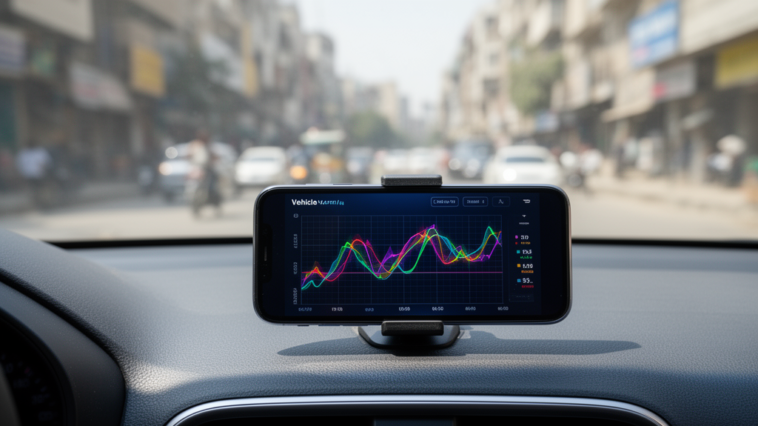
A new smartphone driving dataset behavior analysis from Islamabad, Pakistan, called V-SenseDrive-PK, shows that the behavior labels assigned to drivers primarily reflect changes in speed rather than a fuller picture of driving style. The dataset was gathered on both urban secondary roads and a highway, using only commercially available smartphones inside each vehicle. Researchers reported the findings via bioengineer.org.
This matters because most naturalistic driving datasets have historically come from expensive instrumented vehicles in high-income countries. V-SenseDrive-PK is a deliberate push to document the messy, mixed-traffic realities of a developing region using low-cost hardware that almost any researcher can replicate. That alone makes it a pretty big deal for the global road-safety research community.
Quick Facts
- Dataset name: V-SenseDrive-PK, collected in Islamabad across urban and highway routes.
- Four drivers operated four different vehicles across 47 separate driving trips.
- Total data collected: 11.0 hours of inertial and GPS logs, 11.7 hours of road-facing video, and 516 kilometres of travel.
- Two smartphones per vehicle: one for inertial sensors and GPS, one for 1080p forward-facing video.
- Temporal alignment between video and sensor data achieved a median residual error of just 166 milliseconds after drift correction.
What Actually Happened With the Dataset
Researchers set up each test vehicle with two off-the-shelf smartphones. The first phone logged inertial sensor signals at ten hertz and GPS coordinates at one hertz. The second phone pointed forward and recorded road video at 1080p resolution. No fancy lab equipment, no proprietary sensors. Just the kind of phones you probably already own.
Four drivers each completed sessions meant to represent three behaviour types: normal driving, aggressive driving, and drowsy driving. Those 47 trips across Islamabad’s urban roads and a highway added up to over 500 kilometres of real-world data. That is a solid foundation for any machine learning model trying to understand how people actually drive in Pakistan.
One of the trickier problems in multimodal datasets is making sure the video and the sensor data line up in time. Instead of assuming everything was in sync, the team measured the video-to-sensor alignment individually for every single recording. After correcting for drift, the median timing error came down to 166 milliseconds, which gives future researchers a verified baseline to work from.
That is a significant caveat for anyone planning to train an overall driving behavior recognition model on this data without accounting for that limitation.
Why It Matters
Pakistan’s roads are chaotic in a very specific way. Mixed traffic, varied road conditions, and driving habits that look nothing like what you would see in a European or North American study. Up until now, researchers trying to build driver behaviour models for contexts like this had very little local data to work with.
V-SenseDrive-PK fills that gap, at least partially. The fact that it uses everyday smartphones also means the data collection method is replicable without a big budget. Any university lab or independent researcher in a developing country could follow the same protocol. That is genuinely exciting for the field. If you are curious about other ways Pakistan is showing up in unexpected conversations, the story of the transition of Pakistani cinema is worth a read.
The speed-bias finding in the behaviour labels is equally important as a warning. If you are building a classifier and you do not know that your labels are mostly tracking speed, your model might think it is learning something complex when it is really just learning to detect fast versus slow driving. Knowing this upfront saves a lot of wasted research effort.
Pakistan’s roads also vary enormously by season and setting. Anyone who has navigated city traffic knows how dramatically conditions shift, something the busy wedding season in Pakistan makes very obvious on urban roads. Datasets that reflect those local realities are long overdue.
What Happens Next
Other researchers can now access V-SenseDrive-PK and test their own models against it. The verified temporal alignment and the multimodal nature of the data, combining inertial signals, GPS, and video, make it a useful benchmark for future smartphone-based driver behaviour studies.
The speed-bias issue in the labels also opens a clear research question: can better labelling methods capture a richer picture of driving behaviour, one that goes beyond velocity? That is likely to drive follow-up work, both from the original team and from others who engage with the data. For a look at how Pakistan is building something equally grounded in local conditions, the development of Pakistan’s first eco-tourism village shows the same low-cost, locally rooted approach at work in a completely different field.
About the V-SenseDrive-PK Behavior Labels
Each participant in the study enacted sessions designated as normal, aggressive, and drowsy driving behaviors. As a data article smartphone sensor dataset for driver behavior analysis, the study’s own title confirms that those labels primarily reflect speed, which is an important limitation researchers should factor in when using the data for driver behavior image dataset comparisons or model training.
Frequently Asked Questions
What is the V-SenseDrive-PK dataset?
V-SenseDrive-PK is a naturalistic driving dataset collected in Islamabad, Pakistan, using commercially available smartphones. It includes 11.0 hours of inertial and GPS sensor logs, 11.7 hours of road-facing video, and 516 kilometres of driving data across urban and highway routes. It is designed to reflect the driving conditions of a developing country rather than high-income nations.
How many drivers and trips are included in V-SenseDrive-PK?
The dataset includes four distinct drivers operating four different vehicles across 47 separate driving trips. Each driver completed sessions representing normal, aggressive, and drowsy driving behaviours.
Why do the V-SenseDrive-PK behavior labels primarily reflect speed?
The rule-based labelling system used to tag each driving moment as Normal, Aggressive, or Risky turns out to be strongly influenced by vehicle speed, as stated in the study’s own title. This means the labels capture speed variation more than other dimensions of driving style. Researchers using the dataset for overall driving behavior recognition should account for this when interpreting model outputs.
How did researchers handle time synchronisation between video and sensor data in V-SenseDrive-PK?
Instead of assuming the video and sensor streams were automatically in sync, the team measured alignment on a per-video basis. After applying empirical drift correction, the median residual timing error across all recordings was 166 milliseconds. This verified baseline makes the dataset more reliable for multimodal machine learning research.
What equipment was used to collect the V-SenseDrive-PK data?
Each vehicle carried two commercially available smartphones. One phone recorded inertial sensor data at ten hertz and GPS coordinates at one hertz. The second phone captured forward-facing road video at 1080p resolution, keeping the entire setup low-cost and reproducible.
Where was the V-SenseDrive-PK dataset collected?
All data was collected in Islamabad, Pakistan, across two types of road environments: an urban secondary road and a highway. The choice of locations was intentional, aiming to capture the kind of mixed-traffic conditions common in developing regions that are rarely represented in major driving datasets.
What driving behaviours did participants enact during V-SenseDrive-PK data collection?
Each participant enacted sessions designated as normal, aggressive, and drowsy driving behaviors. The study’s title itself indicates that those labels primarily reflect speed rather than the full range of intended behaviour types.
Final Thoughts
V-SenseDrive-PK is a genuinely useful contribution to road-safety research, especially for anyone focused on driving conditions outside of wealthy, well-documented countries. The speed-bias discovery in the behaviour labels is not a failure. It is exactly the kind of honest, reproducible science that helps the whole field move forward. Keep an eye on how other researchers build on this data.
Related: GTA 6 Price in Pakistan: Release Date, PS5 and Xbox Prices in PKR | Motorola Phones Get Festive Discounts on Flipkart | Nubia Neo 5 Pro, Air Pro and Neo 5 Max 5G Launched in Pakistan: Price and Specs
Source: bioengineer.org
For more trending stories, visit NeemoPani.