Web Author
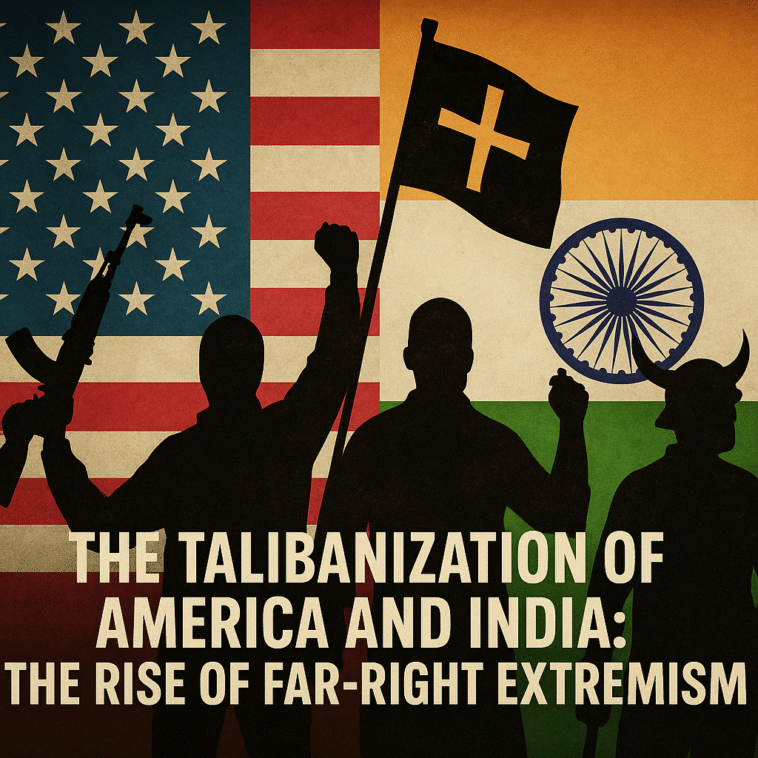
The Talibanization of America and India: The Rise of Far-Right Extremism
In recent years, the world has witnessed a disturbing trend—the rise of far-right extremism in democratic nations, mirroring the authoritarian and regressive ideologies of groups like the Taliban. While the Taliban enforces its rigid interpretation of Sharia law in Afghanistan, elements in the United States and India are pushing their own versions of extremist ideology, threatening secular democracy, minority rights, and social cohesion.
America’s Slide into Far-Right Extremism
The United States, once seen as a global beacon of democracy, has seen a surge in far-right movements that echo Taliban-like authoritarianism. The January 6 Capitol riot was a stark reminder of how extremist ideologies can destabilize even the strongest democracies.
Key Indicators of Talibanization in America:
- Religious Extremism & Christian Nationalism – Far-right groups advocate for a Christian theocracy, seeking to impose biblical laws on a diverse population, much like the Taliban’s enforcement of Sharia.
- Anti-Democratic Tendencies – Efforts to suppress voting rights, undermine elections, and delegitimize opposition mirror authoritarian tactics seen in extremist regimes.
- Violence & Militia Movements – Armed militias like the Proud Boys and Oath Keepers operate with impunity, resembling Taliban-style armed enforcement of ideology.
- Oppression of Women & Minorities – Attacks on abortion rights, LGBTQ+ freedoms, and racial minorities reflect a Taliban-like desire to control personal freedoms.
India’s Hindu Nationalist Extremism
Under Prime Minister Narendra Modi’s Bharatiya Janata Party (BJP), India has seen a sharp rise in Hindu nationalist extremism, drawing comparisons to Taliban-style majoritarianism.
Signs of Talibanization in India:
- Majoritarian Rule Over Secularism – The BJP’s push for a Hindu Rashtra (Hindu nation) undermines India’s constitutional secularism, marginalizing Muslims, Christians, and Dalits.
- Mob Lynchings & Vigilantism – Cow protection squads and anti-Muslim riots (like in Delhi 2020 and Manipur 2023) resemble Taliban-style extrajudicial violence.
- Censorship & Suppression of Dissent – Journalists, activists, and critics are jailed under draconian laws, similar to Taliban crackdowns on free speech.
- Gender Apartheid – Rising attacks on interfaith marriages (“Love Jihad” laws) and restrictions on women’s rights echo Taliban-style patriarchy.
A Global Threat to Democracy
The Talibanization of America and India is not just a domestic issue—it emboldens authoritarianism worldwide. When democracies embrace extremism, they legitimize similar movements elsewhere, eroding global human rights.
The Way Forward
- Strengthening Democratic Institutions – Protecting independent judiciary, free press, and fair elections is crucial.
- Countering Extremist Narratives – Education and media must combat hate propaganda.
- Global Solidarity Against Extremism – Democratic nations must unite against rising authoritarianism.
The choice is clear: either resist Taliban-like extremism or watch democracies crumble into theocracies and autocracies. The future of freedom depends on the actions taken today.
Is this being used by Israel like America used taliban against the Russians
The comparison between Israel’s geopolitical strategies and America’s past use of the Taliban against the Soviets is complex but worth examining. While Israel has not directly created or backed a group equivalent to the Taliban, there are some parallels in how geopolitical interests can lead to unintended consequences, including the empowerment of extremist factions.
1. America’s Use of the Taliban (Mujahideen) Against the Soviets
During the Cold War, the U.S. (via the CIA) and Pakistan’s ISI funded, armed, and trained Afghan mujahideen—including figures like Osama bin Laden—to fight Soviet forces in Afghanistan. This strategy succeeded in bleeding the USSR but later backfired when some of these militants formed Al-Qaeda and the Taliban, turning against the West.
2. Israel’s Historical Alliances with Extremist Groups
Israel has, at times, engaged in realpolitik by indirectly enabling extremist groups to weaken its adversaries, particularly in conflicts involving Iran and its proxies. Some notable cases include:
A. Israel’s Reported Early Support for Hamas
- In the 1970s and 1980s, Israel reportedly allowed the Muslim Brotherhood (Hamas’s precursor) to operate in Gaza as a counterweight to the secular Palestinian Liberation Organization (PLO).
- The logic was similar to the U.S. backing mujahideen: weaken a stronger enemy (PLO/Yasser Arafat) by allowing a religious alternative to grow.
- However, Hamas later turned into a far more extreme and violent adversary than the PLO.
B. Indirect Benefits from Extremist Groups in Syria
- During Syria’s civil war, Israel avoided direct involvement but reportedly turned a blind eye to Sunni jihadist groups (like Hay’at Tahrir al-Sham) fighting Hezbollah and Assad’s regime.
- The logic: Let extremists weaken Iran’s allies, even if they are dangerous in the long run.
3. Key Differences Between U.S.-Taliban and Israel’s Approach
- Direct vs. Indirect Support: The U.S. actively funded and armed the mujahideen, while Israel’s involvement with groups like Hamas was more about tactical tolerance than active creation.
- Blowback Risks: The U.S. faced direct blowback (9/11, Taliban rule in Afghanistan). Israel’s risks are more regional (Hamas’s Oct 7 attack, Hezbollah’s strength).
- Endgame: America’s goal was to defeat the USSR; Israel’s is to weaken Iran’s axis without necessarily wanting extremist Sunni groups to take over.
4. Is Israel Repeating America’s Mistakes?
- Short-Term Gains, Long-Term Threats:Just as the U.S. empowered jihadists against the Soviets, Israel’s past leniency toward Hamas (e.g., allowing Qatari funds into Gaza) may have contributed to its strength.
- Regional Instability: Weakening secular forces (like the PLO) in favor of religious extremists can lead to prolonged conflict, as seen in Gaza.
- Unintended Consequences: Like the Taliban, groups like Hamas or other jihadist factions may become even more dangerous after being temporarily “useful.”
Conclusion
While Israel has not directly replicated the U.S.-Taliban model, its geopolitical maneuvering has sometimes followed a similar logic: “The enemy of my enemy is my temporary friend.” History suggests that such strategies often backfire, empowering radicals who later turn against their former enablers. The key lesson—from Afghanistan to Gaza—is that short-term tactical alliances with extremists can lead to long-term disasters.