Web Author
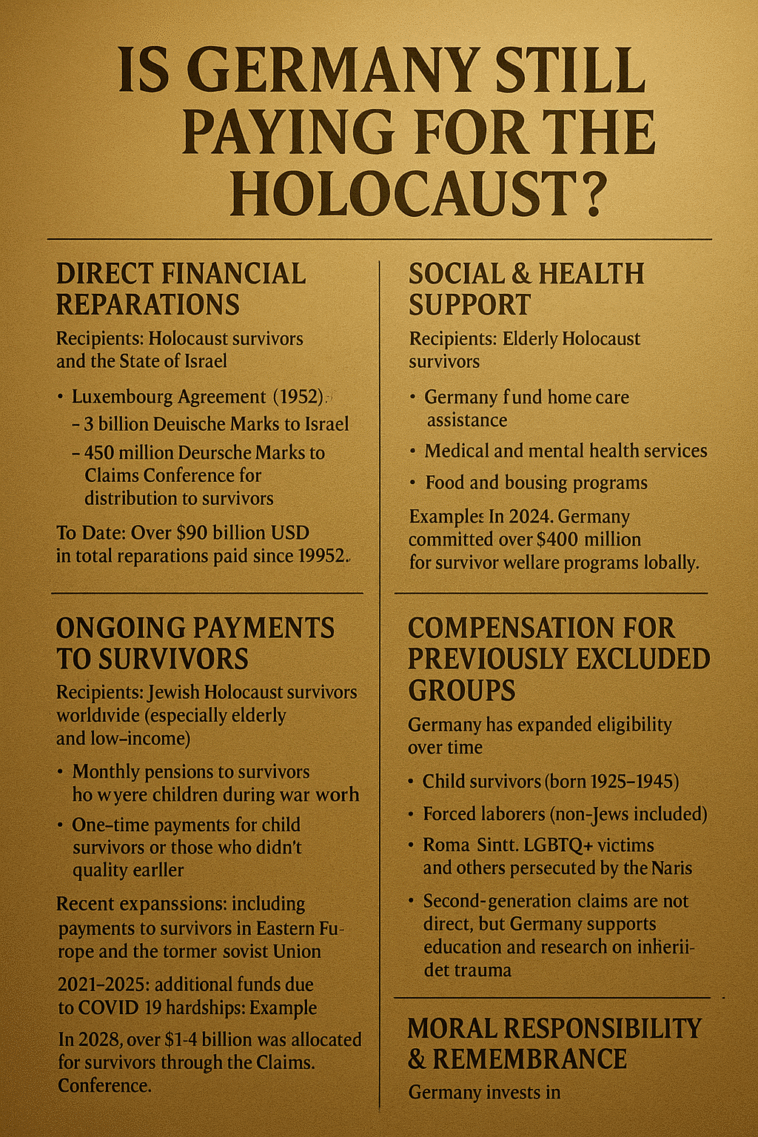
Germany still paying for the holocaust? : nearly a hundred years on
1. Compensation to Survivors
Since the 1950s, Germany has paid over $90 billion in compensation to Holocaust survivors and their descendants.
These payments are managed through various agreements, most notably:
The Luxembourg Agreement (1952) with Israel and the Claims Conference (Conference on Jewish Material Claims Against Germany).
Ongoing negotiations have secured new payments as needs evolved, for elderly and survivors.
2. Ongoing Payments
As of recent years, Germany still provides direct financial support to Holocaust survivors, especially those in Eastern Europe, Israel, and the U.S.
This includes monthly pensions, home care funding, and one-time payments to previously excluded groups (e.g., child survivors, ghettos not previously recognized).
3. Education and Remembrance
Germany also funds Holocaust education, memorials, and museums, both domestically and internationally.
A breakdown.
Here’s a detailed breakdown of how Germany’s current payments and support related to the Holocaust are structured:
🔹 1. Direct Payments to Survivors
A. Monthly Pensions
Who gets them: Holocaust survivors who were persecuted (e.g., in ghettos, concentration camps, or forced into hiding).
Amount: Varies by individual circumstances, but monthly pensions can range from a few hundred to over €1,000.
Administered by: German Federal Ministry of Finance via the Claims Conference.
B. One-Time Payments
Germany has made a series of one-time payments to groups that had previously been left out:
€2,500–€5,000 for child survivors (agreed in 2014).
€1,400 COVID-19 emergency payment (in 2021) for survivors experiencing pandemic-related hardships.
🔹 2. Home Care and Social Services
A. Hardship Fund & Social Welfare
Germany contributes hundreds of millions of euros annually to fund home care, food, medical services, and housing support for elderly survivors.
As of 2023, Germany committed over €1.4 billion ($1.5 billion) for such services in 83 countries.
B. Priority Areas
Survivors in Eastern Europe often receive more support due to historical under-compensation.
Special programs exist for survivors in Israel, the U.S., and former Soviet states.
🔹 3. Ghetto Work Compensation
Germany pays survivors who performed forced or semi-voluntary work in Nazi ghettos (ZRBG payments).
Payments are retroactive pensions, often backdated from applications made in the 2000s.
🔹 4. Education, Memorials, and Remembrance
Germany funds:
Holocaust memorials and museums (e.g., Yad Vashem, Auschwitz Foundation).
Educational initiatives, such as teacher training, textbooks, and memorial tours.
Public commemoration events, especially on International Holocaust Remembrance Day.
🔹 5. Ongoing Negotiations
The Claims Conference negotiates annually or bi-annually with Germany to expand eligibility and adjust compensation based on survivors’ needs and inflation.
Germany’s commitment is seen as open-ended — there’s no fixed “expiration date”