Web Author
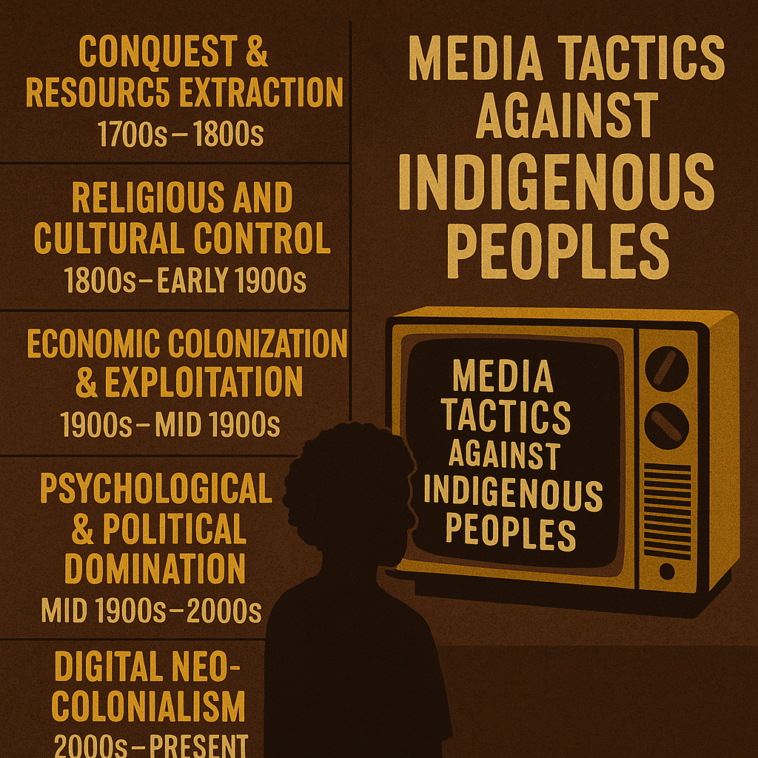
Stages of Colonialism (Last 300 Years) & Media Tactics Against Indigenous Peoples
🌍 Introduction
Over the last three centuries, colonialism has evolved—from overt conquest to subtle economic and psychological domination. At the heart of this ongoing process lies media manipulation, which has played a crucial role in dehumanizing Indigenous peoples and controlling global narratives.
This article examines the five key stages of colonialism and the media tactics used to suppress, divide, or erase Indigenous identities.
🕰️ STAGE 1: Conquest & Resource Extraction (1700s–1800s)
Goal: Gain land, gold, slaves, and spices.
Tactics:
-
Military invasions and occupation
-
Treaties that were manipulated or broken
-
Forced labor and enslavement
Media Role:
-
Print propaganda depicted colonized people as “savages” or “noble but primitive”
-
Justified colonization under the guise of “civilizing missions”
-
Travel literature exaggerated danger, mystery, and backwardness
🗨️ “They do not know God or law. We must guide them.”
🛕 STAGE 2: Religious and Cultural Control (1800s–early 1900s)
Goal: Erase Indigenous identities and replace them with colonial norms.
Tactics:
-
Banning native languages and spiritual practices
-
Mission schools and re-education
-
Criminalizing local customs
Media Role:
-
Promoted Christianity as a symbol of progress
-
Demonized Indigenous spirituality as superstition or witchcraft
-
Published textbooks and children’s stories that erased or rewrote history
🗨️ “Their past is barbaric; our future is their salvation.”
💼 STAGE 3: Economic Colonization & Exploitation (1900s–mid 1900s)
Goal: Control economies through land ownership, labor, and trade.
Tactics:
-
Replacing local trade systems with global capitalist ones
-
Extractive industries (mining, timber, oil) dominated by foreign powers
-
Suppression of Indigenous economic autonomy
Media Role:
-
Portrayed colonial development as charity
-
Celebrated infrastructure (roads, railways) as gifts
-
Blamed poverty on the colonized rather than the system
🗨️ “We brought industry. Why are they still poor?”
📺 STAGE 4: Psychological & Political Domination (Mid 1900s–2000s)
Goal: Maintain control after formal independence.
Tactics:
-
Puppet governments and military aid
-
Covert destabilization of Indigenous movements
-
Psychological colonization (internalized inferiority)
Media Role:
-
News coverage biased toward Western powers
-
Indigenous protests depicted as riots or terrorism
-
Censorship or omission of atrocities against Indigenous peoples
🗨️ “These rebels threaten peace.”
💻 STAGE 5: Digital Neo-Colonialism (2000s–Present)
Goal: Control minds and narratives through technology and global media.
Tactics:
-
Data mining and algorithmic manipulation
-
Cultural appropriation on social media platforms
-
Marginalizing Indigenous creators and journalists
Media Role:
-
Platforms prioritize Western content and aesthetics
-
Erasure of Indigenous voices from mainstream search engines, media, and academia
-
“Diversity” is often tokenized without systemic change
🗨️ “Let’s celebrate them—on our terms.”
🎙️ Countering the Media Narrative
Indigenous peoples across the globe are now:
-
Reclaiming their stories through independent journalism
-
Building digital resistance with language apps, social platforms, and art
-
Educating future generations through ancestral knowledge and storytelling
🌿 “Our existence is our resistance.”
🌐 Conclusion: The Battle Continues
Colonialism is not over. It has simply become more subtle, embedded in media algorithms, textbooks, economic systems, and representation. Understanding its historical stages and media tactics helps us recognize—and resist—its ongoing forms.
Let’s listen to Indigenous voices, amplify them, and challenge the narratives that keep old empires alive in new disguises.