Web Author
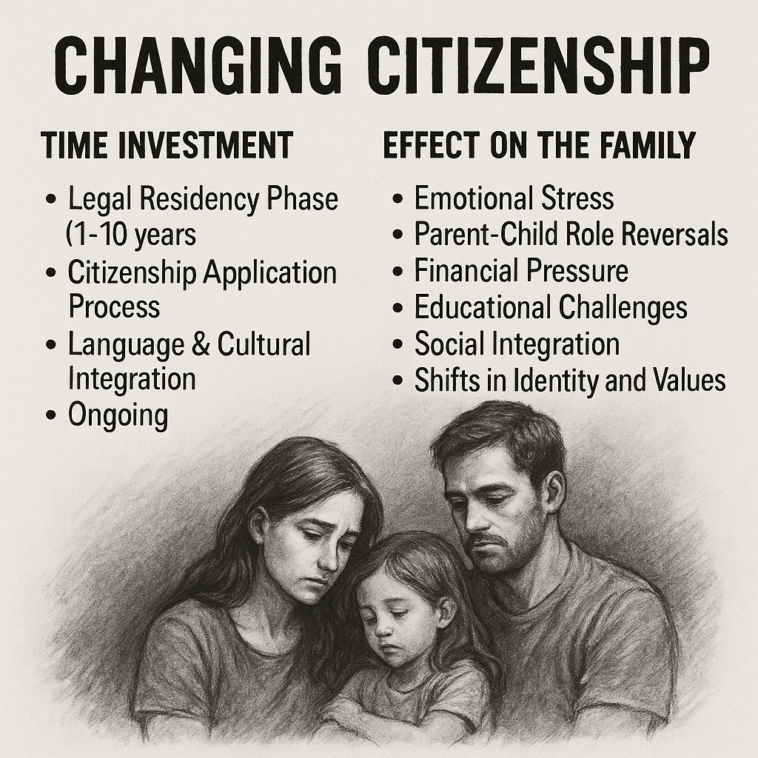
Time, money, and the effect on the family: Immigration / migration
The time and effort required for an immigrant to change citizenship, along with its effects on family, vary significantly depending on factors like the host country’s laws, the immigrant’s origin country, individual circumstances, and family dynamics. Below is a breakdown:
Time Investment to Acquire Citizenship
-
Residency Requirement – Most countries require 3–10 years of legal residency before applying (e.g., USA: 5 years, Canada: 3–5 years, Germany: 6–8 years).
-
Language & Civic Tests – Many nations (UK, Canada, Australia) mandate language proficiency and knowledge of laws/history.
-
Processing Time – After applying, approval can take 6 months to 2+ years (e.g., US naturalization: ~12–18 months, Singapore: ~2 years).
-
Dual Citizenship Rules – Some countries (Japan, India, Germany*) forbid or restrict dual citizenship, forcing immigrants to renounce their original nationality.
(*Germany now allows dual citizenship under certain conditions.)
Financial & Bureaucratic Costs
-
Fees: $500–$2,500+ (e.g., USA: $725, UK: £1,330, Canada: CAD 630).
-
Legal/Consultation Fees: Optional but often needed for complex cases.
-
Travel & Documentation: Some countries require in-person interviews or trips back home.
Effects on Family
-
Spouse & Children – Some nations allow derivative citizenship (e.g., USA permits children under 18 to naturalize with parents). Others require separate applications.
-
Separation Risks – If some family members don’t qualify, they may face prolonged separation.
-
Cultural & Identity Shifts – Children may assimilate faster, while older generations struggle with language/cultural loss.
-
Tax & Legal Obligations – Some countries (e.g., USA) tax global income, affecting financial planning.
-
Elderly Parents – Many nations don’t automatically grant citizenship to parents, forcing long visa processes.
Psychological & Emotional Impact
-
Stress & Uncertainty – Long waiting periods cause anxiety.
-
Identity Crisis – Renouncing original citizenship can feel like losing cultural roots.
-
Family Strain – Differing naturalization statuses may create legal or emotional divides.
Benefits That May Offset the Effort
✔ Visa-free travel (e.g., EU passport allows 27+ country access)
✔ Political rights (voting, running for office)
✔ Job & education opportunities (eligibility for government jobs, scholarships)
✔ Security (protection from deportation, stability for children)
Key Takeaways
-
Total Time: Typically 5–10 years from arrival to citizenship.
-
Family Impact: Can unify or divide, depending on policies and preparation.
-
Long-Term Value: Often worth the effort for stability, but requires sacrifices.